
ArticleReviews
Replying to reviews in Vietnamese and English without losing your voice
How a multi-location business can answer reviews in the reviewer's language, keep one tone and signature everywhere, and avoid the usual translation mistakes
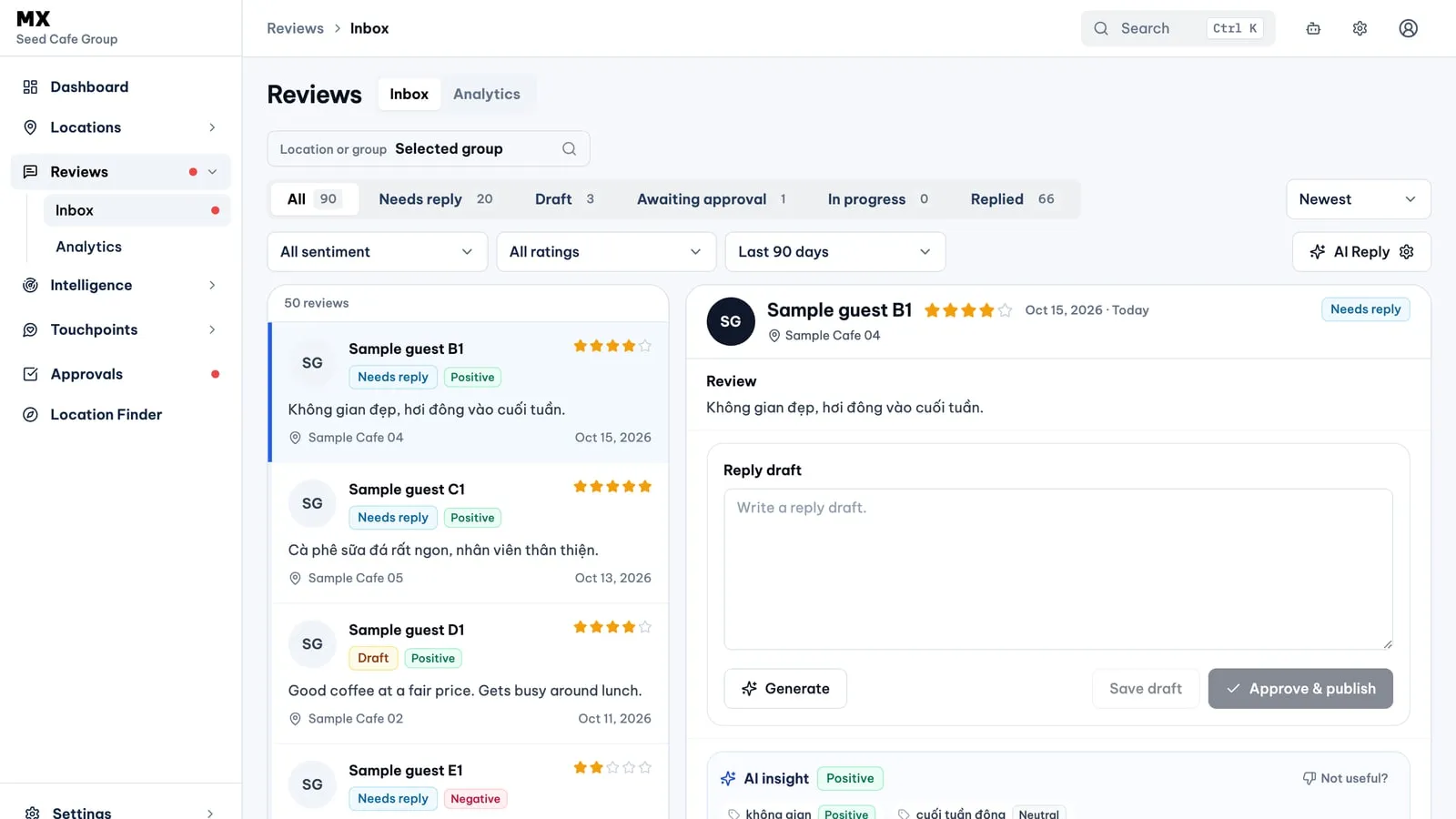
A café chain in Ho Chi Minh City reads “Cà phê ngon, nhân viên thân thiện” in the morning, “The wait at lunch was too long” at noon and a review in Korean by the evening. A hotel in Hội An or a clinic near an expat neighbourhood sees the same mix. Each review deserves an answer the reviewer can read, and every answer should sound like the same business.
That is harder than it looks. Different people at different branches reply in different languages, with different greetings and sign-offs, and a translation tool fills the gaps. The result reads like five companies. Here is a practical way to keep one voice in two languages, and in the occasional third.
Reply in the reviewer’s language
The simplest rule is the one customers notice first: answer in the language the review was written in. A Vietnamese review gets a Vietnamese reply; an English review gets an English one.
Two refinements help a multi-location business:
- Bilingual replies where your audience is mixed. Replies are public, and the next reader may not share the reviewer’s language. Some businesses answer in the reviewer’s language first and add a short version in the other. If you do, keep both parts short and make the second one a full reply in its own right, not a word-for-word copy.
- Tourists’ languages. A review in Korean, Chinese or Japanese deserves at least an attempt in that language, followed by English. Have someone who reads the language check the reply before it goes out, or keep it to a short, simple thank-you that is hard to get wrong.
Write each language, don’t translate it
A reply translated word for word usually sounds stiff in Vietnamese and oddly formal in English. Vietnamese has a choice English doesn’t: how you address the customer. Pick one form of address, such as “bạn” or “anh/chị”, and use it at every location. Mixing them across branches is one of the quickest ways to sound inconsistent.
The same goes for the apology. “We are sorry for the inconvenience” and “Rất tiếc vì trải nghiệm chưa tốt” do the same job, but neither is a literal translation of the other. Write what a good staff member would say in each language.
One signature, one tone
Decide these once and apply them everywhere:
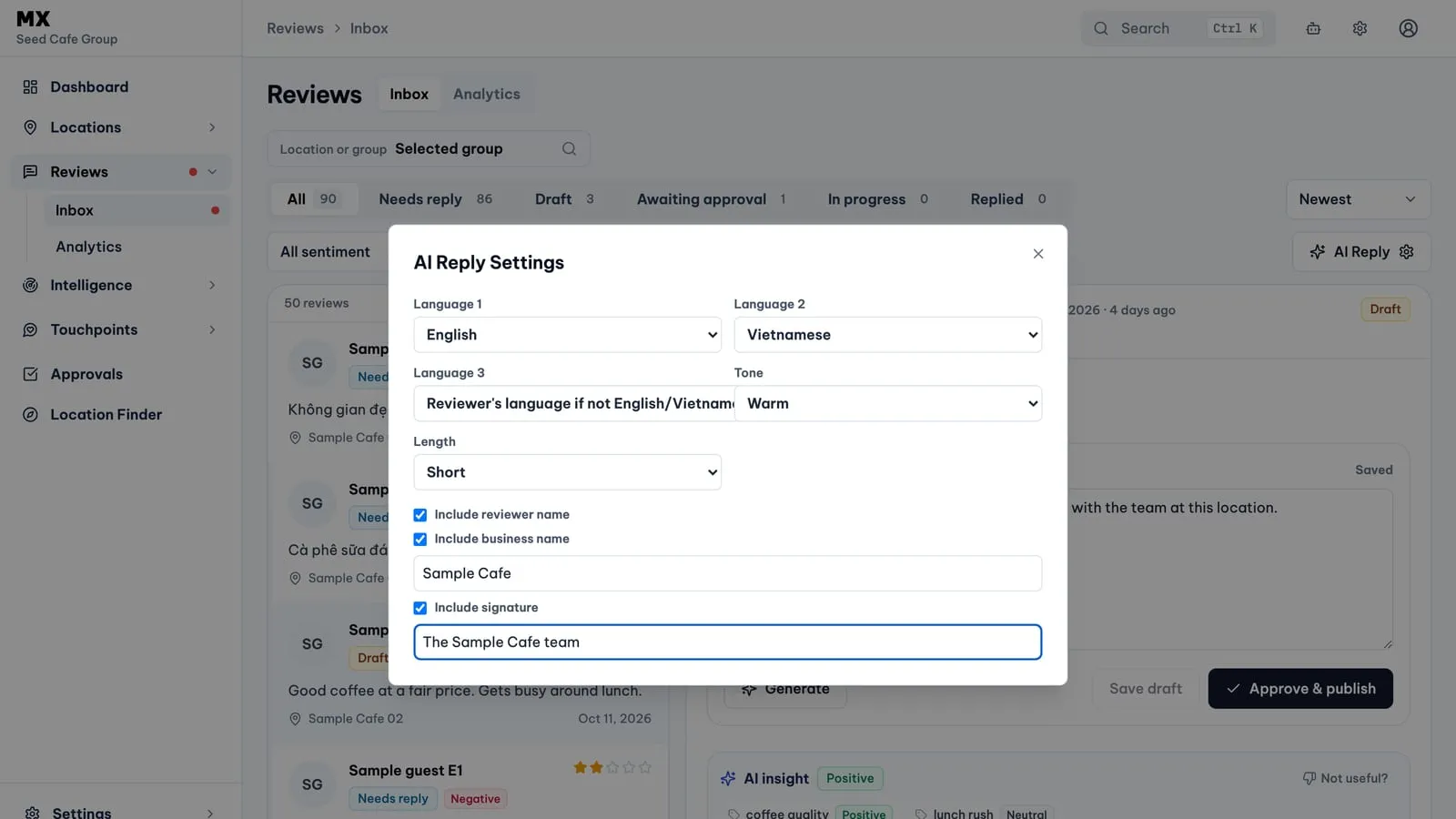
- Sign-off. One line, the same at every branch, such as “The Mây & Mộc team”. If you include the branch name, use the same format each time.
- Tone. Warm or professional. A café can be warm; a bank or a clinic may prefer professional. Either works if every branch uses the same one.
- Length. Google’s tips to write better review replies recommend keeping replies short and simple. Short replies are also easier to keep consistent across two languages.
- The reviewer’s name. Greeting by name feels personal; decide whether you do it, and do it in both languages.
What to avoid
- Raw machine translation. It gets names, dishes and place names wrong, and it misses the tone. Use it as a starting point at most, and have a person read it.
- Promotions and links. Google’s tips ask for replies that are conversational, not promotional, and warn against using a reply to offer deals. A discount in a reply to an unhappy customer also looks like paying for a better review, which Google’s content policy prohibits.
- The same “thank you” everywhere. Google advises against sending the same thank-you to everyone. Mention something from the review, in its language.
- Private details. Never repeat a phone number, booking reference or anything the customer did not make public, in any language.
- Slang and in-jokes. What reads as friendly in Saigon may confuse a reader in Hanoi, and certainly a tourist.
Write a one-page style sheet
The easiest way to keep this consistent is a short document every branch can follow:
- Which languages you reply in, and in what order.
- The form of address in Vietnamese.
- The sign-off, exactly as written.
- Tone and length.
- Words and phrases to avoid in each language.
- Who checks replies in languages other than Vietnamese and English.
Review it every few months with real replies side by side. Inconsistency shows up quickly when two branches’ answers sit next to each other.
Where MX helps
AI Reply in MX turns most of that style sheet into settings. Language 1 and Language 2 can be English, Vietnamese or none, and Language 3 can add the reviewer’s own language when a review is in neither. Each language is written as its own reply, not as a direct translation. You also choose a warm or professional tone, a short or long reply, and whether to include the reviewer’s name, your business name and a signature. The AI review reply guide explains each setting.
Drafts are instructed to leave out links, discounts, incentives and unsupported promises, and to stay cautious with serious complaints. Nothing reaches Google without approval: the company owner drafts and can approve and publish their own reply, and a reply submitted for approval waits in Approvals for an owner, admin or approver. On Pro and Business, automation rules can also submit or send untouched AI drafts for positive reviews only or for all reviews. See Approve review replies before they publish.
Current limits
- AI drafts can be in English and Vietnamese, plus the reviewer’s own language when the review is in neither. There is no fixed choice of a third language.
- A draft is written in the languages you set, not only the review’s: with English and Vietnamese both set, every draft has both.
- There are two tones and two lengths. You cannot add your own instructions or example replies.
- AI Reply settings belong to each person, not to the company, so the style sheet still matters.
- Only the company owner generates AI drafts.
- Free includes 15 AI reply drafts a month; Pro and Business are unlimited.